Categories
Learn

Weekly Market Recap – July 21, 2023

Weekly Recap:

Equities were mixed last week: rate-sensitive sectors (growth and real estate) struggled while shorter-duration, higher dividend-paying sectors (cyclicals and defensives) outperformed. Small and midcaps also outperformed thanks to their less growth-heavy sector weightings.

Normally one might expect that kind of returns distribution to be driven by rising rates, and at the front end of the curve that was certainly the case. In particular, an unexpected fall in weekly initial jobless claims at 228k (consensus =240k; prior week = 237k) pushed short rates higher and increased the odds that the Fed may still have two more rate hikes to go before year-end.

However, yields in the belly of the Treasury curve hardly budged, and long bond yields actually finished the week slightly lower, keeping the US Aggregate index flat on the week. Credit spreads continued their slow grind tighter, pushing corporate bonds prices up a bit.

Away from jobless claims, other economic news last week was mixed. Housing starts and residential building permits both eased back to 1.4mn annualized in June after a sharp rebound on May, but directionally it still appears that housing activity is on the upswing after hitting a trough around the end of 2022. And finally, the Conference Board’s US Leading Economic Index (LEI) fell sequentially for the 15th month in a row, and is at y/y levels that in the past have only been associated with imminent or in-progress recessions (see the Chart of the Week for a 60-year time series).

Chart of the Week: Conference Board US Leading Economic Index (LEI) – Y/Y Change

Albion’s “Four Pillars”:

Economy & Earnings

The US economy showed resilience in the first half of 2023, and Wall Street analysts expect full-year corporate earnings to be roughly flat y/y. Albion’s base case expectation is that the US economy will enter recession in the second half of 2023, putting downside pressure on earnings.

Valuation

The S&P 500’s forward P/E of 19.5x is above the long run average, so valuation could be a headwind to future returns. More predictive metrics like CAPE, Tobin’s Q, and the Buffett Indicator (Mkt Cap / GDP) suggest that compound annual returns over the next decade are likely to be in the mid single digits.

Interest Rates

Rates rose dramatically in 2022 due to a sharp pivot in monetary policy, and have remained elevated in 2023 as progress on inflation has been slower than hoped. Futures markets are currently pricing 1-2 additional 25bp rate hikes over the summer, with no rate cuts expected before year-end.

Inflation

After reaching 40yr highs in spring of 2022, inflation has moderated somewhat over the past 12 months. Goods inflation has fallen due to softening demand and excess inventory, while services inflation remains elevated, in part due to shelter costs which are somewhat lagged.

Categories
Learn

Weekly Market Recap – July 14, 2023

Weekly Recap:

Better-than-expected inflation data drove rates lower across most of the curve last week, which in turn facilitated P/E multiple expansion and sent stocks higher.

The party got started in earnest on Tuesday, when core and headline CPI both came in below expectations for the month of June. Closely watched core CPI was just +0.2% m/m and fell to +4.8% y/y, while headline CPI also printed at +0.2% m/m and dropped to +3.0% y/y thanks to much lower energy prices relative to this time last year. See the Chart of the Week for a time series of the y/y change in core and headline CPI.

Further upstream, PPI printed at +0.1% m/m across the board (headline, core, and ex trade), with headline PPI nearly entering outright deflation territory for the first time since 2020 at just +0.1% on a y/y basis as well.

The inflation news sent rates lower across the curve, and the likelihood of a second additional rate hike before year-end flipped from odds-on to odds-off (a single 25bp hike at the July meeting appears all but assured at this point).

P/E multiples flexed up on falling discount rates, pushing most US equity benchmarks higher by 2-3% with duration-sensitive growth sectors outperforming. International stocks also outperformed, but continue to lag the US on a YTD basis.

Chart of the Week: Headline and Core CPI (y/y change)

Albion’s “Four Pillars”:

Economy & Earnings

The US economy showed resilience in the first half of 2023, and Wall Street analysts expect full-year corporate earnings to be roughly flat y/y. Albion’s base case expectation is that the US economy will enter recession in the second half of 2023, putting downside pressure on earnings.

Valuation

The S&P 500’s forward P/E of 19x is above the long run average, so valuation could be a headwind to future returns. More predictive metrics like CAPE, Tobin’s Q, and the Buffett Indicator (Mkt Cap / GDP) suggest that compound annual returns over the next decade are likely to be in the mid single digits.

Interest Rates

Rates rose dramatically in 2022 due to a sharp pivot in monetary policy, and have remained elevated in 2023 as progress on inflation has been slower than hoped. Futures markets are currently pricing 1-2 additional 25bp rate hikes over the summer, with no rate cuts expected before year-end.

Inflation

After reaching 40yr highs in spring of 2022, inflation has moderated somewhat over the past 12 months. Goods inflation has fallen due to softening demand and excess inventory, while services inflation remains elevated, in part due to shelter costs which are somewhat lagged.

Categories
Learn

Weekly Market Recap – July 7, 2023

Weekly Recap:

Last week was a tough one for stocks and bonds alike, as resilient labor market data lent support to the Fed’s “higher for longer” interest rate road map:

  • JOLTS job openings remained historically elevated at 9.8 million
  • ADP employment change nearly doubled m/m at 497k for May
  • Nonfarm payroll growth of 209k in June was the 30th straight month over 200k
  • U-3 unemployment fell 10bp to 3.6%
  • Average hourly earning growth accelerated to +0.4% m/m and +4.4% y/y

Minutes from the June FOMC meeting were also released last week, and painted a picture of a less unified committee than the unanimous decision to pause might have suggested. Some committee members had advocated for raising rates by another 25bp, specifically because of the historically tight labor market.

The combination of somewhat hawkish meeting minutes and the ensuing strong labor market data has convinced most investors that another 25bp rate hike is coming at the FOMC meeting later this month. Meanwhile, the belly and long end of the Treasury curve shifted higher by ~20bp as investors recalibrated their longer term inflation and interest rate expectations, pushing the entire curve above 4% for the first time since October/November of last year.

The incrementally more hawkish outlook for monetary policy pushed equity prices lower as well. The selling was broad-based across sectors, market caps, and geographies, with most US and global benchmarks down 1-2% on the week.

Chart of the Week: Nonfarm Payrolls Added

Albion’s “Four Pillars”:

Economy & Earnings

The US economy showed resilience in the first half of 2023, and Wall Street analysts expect full-year corporate earnings to be roughly flat y/y. Albion’s base case expectation is that the US economy will enter recession in the second half of 2023, putting downside pressure on earnings.

Valuation

The S&P 500’s forward P/E of 19x is above the long run average, so valuation could be a headwind to future returns. More predictive metrics like CAPE, Tobin’s Q, and the Buffett Indicator (Mkt Cap / GDP) suggest that compound annual returns over the next decade are likely to be in the mid single digits.

Interest Rates

Rates rose dramatically in 2022 due to a sharp pivot in monetary policy, and have remained elevated in 2023 as progress on inflation has been slower than hoped. Futures markets are currently pricing 1-2 additional 25bp rate hikes over the summer, with no rate cuts expected before year-end.

Inflation

After reaching 40yr highs in spring of 2022, inflation has moderated somewhat over the past 12 months. Goods inflation has fallen due to softening demand and excess inventory, while services inflation remains elevated, in part due to shelter costs which are somewhat lagged.

Categories
Learn

Weekly Market Recap – June 23, 2023

Weekly Recap:

Stocks moved lower last week on a cocktail of soft economic data and a reminder from Jerome Powell that the Fed is not done raising interest rates. On the latter point, Powell testified before the US Senate Banking Committee that “it will be appropriate to raise rates again this year, and perhaps twice.” Fed fund futures have not yet bought into the notion of multiple additional rate hikes this year, but are now taking Powell at his word that there will be one more, and the no rate cuts will occur until at least early 2024.

Macro data was mostly weaker last week, with one exception: housing. Residential building permits rose to nearly 1.5 million, while housing starts jumped to more than 1.6 million, with significant increases in both single-unit and multi-family. Absent a recession, it increasingly appears that the cyclical trough in US housing activity may have occurred around the start of this year.

Otherwise, macro data released last week was not encouraging. Initial jobless claims printed at 264k, pulling the 4-week moving average above 250k for the first time since November of 2021. Meanwhile, S&P Global’s US Composite PMI slipped sequentially in the preliminary June reading, with m/m declines in the manufacturing and services components. And finally, the Conference Board’s Leading Economic Index (LEI) fell sequentially for the 14th consecutive month.

The consequence of all this was a broad-based pullback in US stocks, with cyclical sectors (industrials, materials, financials, and energy) all underperforming as the nearterm direction of the economy became the primary concern.

Chart of the Week: Conference Board LEI (y/y change)

Albion’s Four Pillars:

Economy & Earnings

The US economy enjoyed a strong second half of 2022, but growth has slowed in early 2023 and corporate operating margins have fallen as labor and input cost pressures bite. Albion’s base case expectation is that the US economy will enter recession in 2023, putting downside pressure on earnings.

Valuation

The S&P 500’s forward P/E of 19x is above the long run average, so valuation could be a mild headwind to future returns. More predictive metrics like CAPE, Tobin’s Q, and the Buffett Indicator (Mkt Cap / GDP) suggest that compound annual returns over the next decade are likely to be in the mid single digits.

Interest Rates

Rates rose dramatically in 2022 in response to a sharp pivot in monetary policy, and have remained elevated in 2023 as progress on inflation has been slower than hoped. Futures markets are currently pricing one additional 25bp rate hike over the summer, with no rate cuts expected before year-end.

Inflation

After reaching 40yr highs in spring of 2022, inflation has moderated somewhat over the past 12 months. Goods inflation has fallen due to softening demand and excess inventory, while services inflation remains elevated, in part due to shelter costs which are somewhat lagged.

Categories
Learn

Elon Musk Biographer Speaks with Doug Wells About Latest Book

Elon Musk’s biographer Ashlee Vance was interviewed this week by Albion Partner Doug Wells on his KPCW radio program Mountain Money on the subject of Vance’s new book “When the Heavens Went on Sale”

Doug Wells interviews Ashlee Vance on KPCW’s ‘Mountain Money’

Ashlee Vance is an American business columnist and author, best known for his biography of Elon Musk, titledย โ€œElon Musk: Tesla, SpaceX, and the Quest for a Fantastic Futureโ€ย which was released in 2015.

The biography traces Muskโ€™s journey from his difficult upbringing in South Africa to his ascent to the pinnacle of the global business world. The book provides an outline of the experiences that have made Musk the man he is today, and how he has always dreamed big.

Vance’s new book calledย โ€œWhen the Heavens Went on Sale: The Misfits and Geniuses Racing to Put Space Within Reachโ€ tells the remarkable, unfolding story of a frenzied low Earth orbit “land grab.”

Through his trademark immersive reporting, Vance follows four pioneering companiesโ€”Astra, Firefly, Planet Labs, and Rocket Labโ€”as they build new space systems and attempt to launch rockets and satellites into orbit by the thousands.

While the public fixated on the space tourism being driven by Elon Musk, Jeff Bezos, and Richard Branson, these new companies arrived with a different set of goals: to make rocket and satellite launches fast and cheap, thereby opening Earthโ€™s lower orbit for businessโ€”and setting it up as the next playing field for humankindโ€™s technological evolution.

Categories
Learn

Weekly Market Recap – June 9, 2023

Weekly Recap

Stocks enjoyed a melt-up during a quiet macro period ahead of this week’s May CPI report and the June FOMC meeting. Cyclicals generally outperformed despite fairly tepid (and limited) macro data, suggesting that duration played a key role in relative sector performance. Small caps were also better, driven in large part by their higher cyclical exposure.

Rates backed up a bit last week as market participants continued to price in a “higher for longer” Fed policy path, pushing high grade bond prices lower. Spreads have stabilized after widening into the debt ceiling deadline and then rallying when a deal was struck and a US default was avoided.

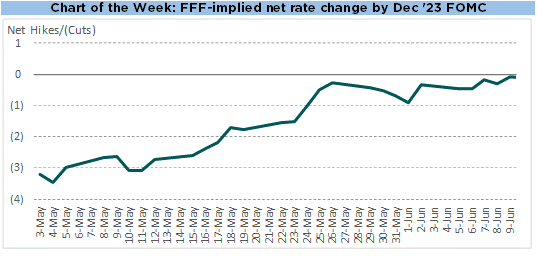
Fed fund futures were little changed on the front end last week, still pricing in a 30% chance of a hike at the June meeting. But odds of one or more rate cuts by year-end continue to ease lower, and have fallen significantly since the first few days after the May FOMC meeting. At the close on May 3rd (after the FOMC rate announcement and press conference), futures markets were pricing in no more hikes and 3.5 rate cuts by year-end.

Fast forward to the present, and futures markets imply that there is likely to be a hike at one of the next two meetings, and one cut by year-end, for a net rate change of zero. See the Chart of the Week for a time series of year-end net Fed Funds rate changes from May 3rd through Friday’s close.

Chart of the Week: FFF-implied net rate change by Dec ’23 FOMC

Albion’s “Four Pillars”

Economy & Earnings

The US economy enjoyed a strong second half of 2022, but growth has slowed in early 2023 and corporate operating margins have fallen as labor and input cost pressures bite. Albion’s base case expectation is that the US economy will enter recession in 2023, putting downside pressure on earnings.

Valuation

The S&P 500’s forward P/E of 18x is above the long run average, so valuation could be a mild headwind to future returns. More predictive metrics like CAPE, Tobin’s Q, and the Buffett Indicator (Mkt Cap / GDP) suggest that compound annual returns over the next decade are likely to be in the mid single digits.

Interest Rates

Rates rose dramatically in 2022 in response to a sharp pivot in monetary policy, and have remained elevated in 2023 as progress on inflation has been slower than hoped. Futures markets are currently pricing one additional 25bp rate hike over the summer, and one rate cut near the end of the year.

Inflation

After reaching 40yr highs in spring of 2022, inflation has moderated somewhat over the past 12 months. Goods inflation has fallen due to softening demand and excess inventory, while services inflation remains elevated, in part due to shelter costs which are somewhat lagged.

Categories
Learn

Weekly Market Recap – June 2, 2023

Weekly Recap

Stocks and bonds rallied in unison last week as the US debt ceiling drama was resolved without a government default. Unlike the prior week, where gains were limited to a relative handful of A/I and chip-related stocks, last week’s move higher in stocks was broad based. All sectors in the S&P 500 finished in the green, with cyclicals and growth stocks leading the way while staples lagged the rally a bit.

Bonds rallied too, as whatever default premium had been baked into Treasury yields was quickly removed by investors. Public commentary from Fed officials favoring a June pause was also helpful, driving the odds of a 25bp hike next week from 70% at the end of the prior week to just 30% by Friday’s close. Credit spreads finished modestly tighter as well.

On the economic front, the main message from incoming data was that labor markets remain strong. JOLTS job openings reversed a recent trend towards normalization with a print of 10.1 million, ADP employment significantly exceeded expectations, and jobless claims were steady.

Meanwhile, the monthly jobs report from the BLS showed strong payroll gains, but also a modest uptick in the unemployment rate, a sequential decline in hours worked, and mild deceleration in the rise in average hourly earnings:

  • Change in Nonfarm Payrolls = +339k (cons. est. +195k)
  • Unemployment rate = 3.7% (prior month = 3.4%)
  • Average weekly hours = 34.3 (prior month = 34.4)
  • Average hourly earnings = +4.3% y/y (prior month = +4.4% y/y)
Chart of the Week: Monthly Nonfarm Payrolls Added

Albion’s “Four Pillars”

Economy & Earnings

The US economy enjoyed a strong second half of 2022, but growth has slowed in early 2023 and corporate operating margins have fallen as labor and input cost pressures bite. Albion’s base case expectation is that the US economy will enter recession in 2023, putting downside pressure on earnings.

Valuation

The S&P 500’s forward P/E of 18x is above the long run average, suggesting that valuation could be a mild headwind to future returns. More predictive metrics like CAPE, Tobin’s Q, and the Buffett Indicator (Mkt Cap / GDP) suggest that compound annual returns over the next decade are likely to be in the mid-single digits.

Interest Rates

Rates rose dramatically in 2022 in response to a sharp pivot in monetary policy, and have remained elevated in 2023 as progress on inflation has been slower than hoped. Futures markets are currently pricing one additional 25bp rate hike over the summer, with the possibility of rate cuts near the end of the year.

Inflation

After reaching 40yr highs in spring of 2022, inflation has moderated somewhat over the past 12 months. Goods inflation has fallen due to softening demand and excess inventory, while services inflation remains elevated, in part due to shelter costs which are somewhat lagged.

Categories
Learn

Weekly Market Recap – May 26, 2023

Weekly Recap

Last week saw a concentrated rally in technology stocks after GPU manufacturer Nvidia provided an updated forecast for revenue growth that far exceeded analysts’ expectations. In particular, any stock that investors believed to be A/I- or semiconductor-related saw strong buying pressure. Meanwhile, most other companies and sectors finished the week lower despite slow-but-steady progress towards a debt ceiling deal over the course of the week.

Macro data was a bit less cooperative, however, particularly on the inflation front as the PCE Deflator came in higher than expected in freshly released April data:

  • Headline PCE m/m = +0.4% (+0.3% cons est; +0.1% prior month)
  • Headline PCE y/y = +4.4% (+4.3% cons est; +4.2% prior month)
  • Core PCE m/m = +0.4% (+0.3% cons est; +0.3% prior month)
  • Core PCE y/y = +4.7% (+4.6% cons est; +4.6% prior month)

Stubborn inflation sent rates higher on the week, particularly in the front end as investors priced in one additional 25bp rate hike over the summer. Futures markets are fairly evenly split as to whether that hike will occur at the June or July meeting, while expectations of rate cuts in the back half of the year are gradually waning.

Other macro data released last week mostly suggested a resilient economy. Personal incomes and spending rose more than expected in April, as did durable goods orders. In addition, there was a modest rebound in the University of Michigan’s consumer sentiment gauge, with assessment of current conditions improving while consumers’ near and longer-term inflation expectations fell.

Chart of the Week: Core PCE Deflator (y/y change)

Albion’s “Four Pillars”

Economy & Earnings

The US economy enjoyed a strong second half of 2022, but growth has slowed in early 2023 and corporate operating margins have been gradually falling as labor and input cost pressures bite. Albion’s base case expectation is that the US economy will enter recession in 2023, putting downside pressure on earnings.

Valuation

The S&P 500’s forward P/E of 18x is above the long run average. More predictive metrics like CAPE, Tobin’s Q, and the Buffett Indicator (Mkt Cap / GDP) suggest that compound annual returns over the next decade are likely to be below the long-run historical average.

Interest Rates

Rates rose dramatically in 2022 in response to a sharp pivot in monetary policy, and have remained elevated so far in 2023 as progress on inflation has been slow. Futures markets are currently pricing one additional 25bp rate hike over the summer, with the possibility of rate cuts in the back half of the year.

Inflation

After reaching 40yr highs in spring of 2022, inflation has moderated somewhat over the past 12 months. Goods inflation has fallen due to softening demand and excess inventory, while services inflation remains elevated, in part due to shelter costs which are somewhat lagged.

Categories
Learn

Weekly Market Recap – May 19, 2023

Weekly Recap:

Markets were volatile day by day last week as optimism around a debt ceiling deal ebbed and flowed. A strong two-day rally on Wednesday and Thursday eventually ran out of steam as it became clear that a deal was not going to take place before the weekend, leading to a small pullback on Friday. Still, all major US equity benchmarks finished solidly in the green, with growth stocks leading the way and defensive sectors firmly on the back foot.

Renewed appetite for risk assets was clearly reflected in fixed income markets as well. Bond prices fell as rates rose across the curve, and credit spreads tightened.

While not front and center on investors’ minds last week, macroeconomic data continued to paint a picture of a slowing US economy, albeit not universally. Signs of deceleration included:

  • Empire Manufacturing sunk back into contraction territory at -31.8
  • Philly and New York Fed regional surveys remained in the contraction zone
  • Existing home sales, residential building permits, and mortgage applications all fell
  • Initial jobless claims (242k) remain elevated relative to recent cycle lows
  • The Conference Board’s Leading Economic Index (LEI) fell to a fresh cycle low

On a more positive note:

  • Retail sales for April (+0.4% m/m) rebounded after falling in March
  • The National Association of Home Builders market index rose to 50 (neutral)
  • Industrial Production rose 0.5% in April, while Capacity Utilization increased +30bp
Chart of the week: Conference Board LEI (v/v change)

Albion’s “Four Pillars”:

Economy & Earnings

The US economy enjoyed a strong second half of 2022, but growth has slowed in early 2023 and corporate operating margins have been gradually falling as labor and input cost pressures bite. Albion’s base case expectation is that the US economy will enter recession in 2023, putting downside pressure on earnings.

Valuation

The S&P 500’s forward P/E of 18x is above the long run average. More predictive metrics like CAPE, Tobin’s Q, and the Buffett Indicator (Mkt Cap / GDP) suggest that compound annual returns over the next decade are likely to be below the long-run historical average.

Interest Rates

Rates rose in 2022 in response to a sharp pivot in monetary policy, but have been steady to slightly lower across most of the curve so far in 2023. Futures markets are currently pricing a Fed pause after 500bp of hikes over the past 14 months, with the possibility of rate cuts in the back half of the year.

Inflation

After reaching 40yr highs in spring of 2022, inflation has moderated somewhat over the past 12 months. Goods inflation has fallen due to softening demand and excess inventory, while services inflation remains elevated, in part due to shelter costs which are somewhat lagged.

Categories
Learn

Weekly Market Recap – May 12, 2023

Weekly Recap:

Most stocks and bonds were modestly lower last week despite April CPI numbers coming in a tiny bit better than expected. While the m/m change in both core and headline CPI registered at +0.4%, the y/y change in headline CPI (the most commonly cited inflation figure) fell to 4.9%, ending a 23-month period where inflation was greater than 5% on a y/y basis (the last sub-5% print was in April of 2021).

Notably, the opposing trends in inflation (lower) and overnight interest rates (higher) have brough the two together, creating an environment where nominal yields on cash equivalents (money market funds, short term Treasuries, and CD’s) equal or exceed inflation. Positive real yields on cash have been a rare occurrence in the period since the 2008/09 financial crisis, occurring only briefly in 2019 after the conclusion of the Fed’s previous hiking cycle. See the Chart of the Week for a time series of prime money market fund (SWVXX) yield versus the y/y change in CPI.

Despite the trend lower in inflation, investors’ expectations of near term rate cuts waned a bit last week, and the Treasury curve shifted higher. Meanwhile, risk assets continue to be impacted by anxiety around the debt ceiling deadline, with stocks and commodities finishing lower while credit spreads widened.

A notable exception to the general market weakness was Google, which rocketed higher by more than 11% last week after the company showcased a number of advancements in its use of generative A/I at the company’s annual “Google I/O” developer conference. Google’s surge was enough to pull the Comms sector into positive territory on the week, and helped the Nasdaq eke out a small gain as well.

Chart of the Week: Money Market Fund Yield versus y/y Headline CPI

Albion’s “Four Pillars”:

Economy & Earnings

The US economy enjoyed a strong second half of 2022, but corporate operating margins have been gradually falling as labor and input cost pressures bite. Albion’s base case expectation is that the US economy will enter recession in 2023, putting downside pressure on earnings.

Valuation

The S&P 500’s forward P/E of 18x is above the long run average. More predictive metrics like CAPE, Tobin’s Q, and the Buffett Indicator (Mkt Cap/GDP) suggest that compound annual returns over the next decade are likely to be in the single digits.

Interest Rates

Rates rose in 2022 in response to a sharp pivot in monetary policy but have mostly fallen (except for the very front end) so far in 2023. Futures markets are currently pricing a Fed pause after 500bp of hikes over the past 14 months, with the possibility of rate cuts in the back half of the year.

Inflation

After reaching 40yr highs in spring of 2022, inflation moderated in the second half of the year. Goods inflation has fallen due to softening demand and excess inventory, while services inflation remains elevated, in part due to shelter costs which are somewhat lagged.